Recently, I decided to watch the pilot episode for the NBC tv show, Parks and Recreation, originally aired in 2009. After watching the episode and reading about Marxist rhetorical critiques, I thought it would be pretty interesting to do a miniature Marxist critique of the pilot episode.
While Marx had many interesting concepts, the one I am particularly interested in is the idea of “false consciousness” and how to “demystify” a society or individual from this distorted sense of reality. In the textbook, Rhetoric and Human Consciousness, Craig Smith describes Marx’s idea of false consciousness as illusions that are “an outgrowth of the material interests of those in power and can be revealed as false by comparing them to the material realities of the world” (325). This brings us to the process of demystification, which for contemporary Marxists, often involves asking a series of questions designed to help the audience “uncover material realities and those who control them” (327).
When applied to the pilot episode of Parks and Recreation, these questions expose the interesting dynamic between those who have the power and those who don’t. Furthermore, the viewer soon realizes that the show is intentionally engaging with the public’s “false consciousness” towards the government.

The plot of the pilot episode is as follows: Leslie Knope is the deputy director of the town’s Parks and Recreation department. She and a colleague hold a community outreach public forum. One woman named Anne Perkins stands up and informs them of an abandoned lot on the street she lives in. She asks for them to fill it because her boyfriend broke both of his legs when he fell in. Leslie “pinkie promises” to do it, and she spends the rest of the episode trying to create a subcommittee to not only fill in the pit, but also build a park on that land. Finally, after appealing to higher authorities, falling into the pit herself, and spending more time with Anne, Leslie is given the subcommittee.
The first few questions for this Marxist critique each deal with the idea of speaking: who gets to speak, who has the power to, who can afford to, and more. Interestingly, the episode starts with Leslie trying to get a child at a park to answer her survey questions about their satisfaction at the park. This already sets up the power dynamic. The child is allowed to speak, but the system is not typically set up in such a way that privileges the feedback of the children in the park. In fact, when the child refuses to talk, Leslie assumes an answer and fills in the survey for them. In this sense, she is controlling their “message” and thereby taking the role as speaker.
This idea of who gets to speak is revisited again in the community outreach public forum. Technically this event is created so that community members can ask questions. However, as shown by their reactions to Anne’s statement that she doesn’t really like politics, the community seems to be aware that their complaints will only go so far. This is also seen in Anne’s surprised reaction when Leslie actually pinky promises to not only fill the pit, but also to put a park on the land. Basically, by actually listening to Anne speak, Leslie is going against the status quo to a certain degree. She is attempting to align the “material interests of those in power” with the “material realities” of the need to fill this pit.
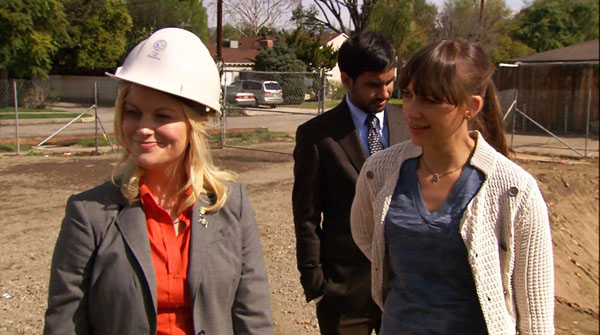
Ironically, however, Leslie’s own view of government work is a kind of false consciousness. This can be seen in the other character’s responses to her optimism towards government work. She seems to be stuck in an idealistic understanding of local government. Despite this, her attempts to get the subcommittee show that she is aware of the systemic strategies of the local government and that as a participant in that system, there is a hierarchy. Consequently, she appeals to those who can help her gain traction within this system

In the end, this episode’s concern with the power structures of the local government, specifically who can speak and who is privileged, reveal numerous characters who are attempting to deal with this false consciousness surrounding their local government. Ultimately they must recognize the material realities of their situations and of the government structure in order to escape this false consciousness and thereby appeal to or align their goals with the material interests of the Parks and Recreation department.
 Notes in the Margins